An integrated map of genetic variation from 1,092 human genomes
Published: 31 October 2012
The 1000 Genomes Project Consortium
Here we describe the genomes of 1,092 individuals from 14 populations, constructed using a combination of low-coverage whole-genome and exome sequencing.
We show that individuals from different populations carry different profiles of rare and common variants, and that low-frequency variants show substantial geographic differentiation, which is further increased by the action of purifying selection.
【commonは5%以上】
However, although more than 95% of common (>5% frequency) variants were discovered in the pilot phase of the 1000 Genomes Project, lower-frequency variants, particularly those outside the coding exome, remain poorly characterized.
Low-frequency variants are enriched for potentially functional mutations, for example, protein-changing variants, under weak purifying selection1,5,6
Furthermore, because low-frequency variants tend to be recent in origin, they exhibit increased levels of population differentiation6,7,8.
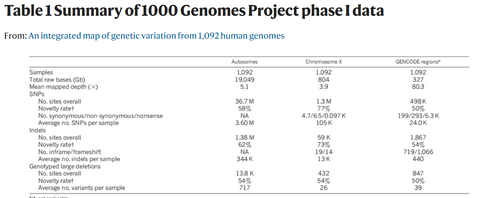
A key goal of the 1000 Genomes Project was to identify more than 95% of SNPs at 1% frequency in a broad set of populations.
For example, within Europe, the IBS and FIN populations carry excesses of rare variants (Supplementary Fig. 6b), which can arise through events such as recent bottlenecks10, ‘clan’ breeding structures11 and admixture with diverged populations12.
Because rare variants are typically recent, their patterns of sharing can reveal aspects of population history.
Rates of variant discovery, the ratio of non-synonymous to synonymous variation and the proportion of variants that are new vary systematically between regions with different ancestries.
A simple way of estimating the segregating load arising from rare, deleterious mutations across a set of genes comes from comparing the ratios of non-synonymous to synonymous variants in different frequency ranges.
The non-synonymous to synonymous ratio among rare (<0.5%) variants is typically in the range 1–2, and among common variants in the range 0.5–1.5, suggesting that 25–50% of rare non-synonymous variants are deleterious.
Moreover, the excess of rare non-synonymous variants is typically higher in populations of European and East Asian ancestry (for example, the ECM–receptor interaction pathway load is strongest in European populations). Other groups of genes (such as those associated with allograft rejection) have a high non-synonymous to synonymous ratio in common variants, potentially indicating the effects of positive selection.
Although the magnitude of the effect is weak, non-synonymous variants consistently show greater levels of population differentiation than synonymous variants, for variants of frequencies of less than 10% (Supplementary Fig. 13).
Data from the 1000 Genomes Project are widely used to screen variants discovered in exome data from individuals with genetic disorders22 and in cancer genome projects23.
A second major use of the 1000 Genomes Project data in medical genetics is imputing genotypes in existing genome-wide association studies (GWAS)26.
Moreover, it argues for the value of continuing to sequence individuals from diverse populations to characterize the spectrum of human genetic variation and support disease studies across diverse groups. A further 1,500 individuals from 12 new populations, including at least 15 high-depth trios, will form the final phase of this project.
Published: 31 October 2012
The 1000 Genomes Project Consortium
1000ゲノムプロジェクトの結果発表論文。赤字にしたように、非動義変異の25から50%は有害と明言
Abstract
Here we describe the genomes of 1,092 individuals from 14 populations, constructed using a combination of low-coverage whole-genome and exome sequencing.
We show that individuals from different populations carry different profiles of rare and common variants, and that low-frequency variants show substantial geographic differentiation, which is further increased by the action of purifying selection.
【commonは5%以上】
However, although more than 95% of common (>5% frequency) variants were discovered in the pilot phase of the 1000 Genomes Project, lower-frequency variants, particularly those outside the coding exome, remain poorly characterized.
Low-frequency variants are enriched for potentially functional mutations, for example, protein-changing variants, under weak purifying selection1,5,6
Furthermore, because low-frequency variants tend to be recent in origin, they exhibit increased levels of population differentiation6,7,8.

A key goal of the 1000 Genomes Project was to identify more than 95% of SNPs at 1% frequency in a broad set of populations.
Genetic variation within and between populations
For example, within Europe, the IBS and FIN populations carry excesses of rare variants (Supplementary Fig. 6b), which can arise through events such as recent bottlenecks10, ‘clan’ breeding structures11 and admixture with diverged populations12.
Because rare variants are typically recent, their patterns of sharing can reveal aspects of population history.
Rates of variant discovery, the ratio of non-synonymous to synonymous variation and the proportion of variants that are new vary systematically between regions with different ancestries.
The functional spectrum of human variation
A simple way of estimating the segregating load arising from rare, deleterious mutations across a set of genes comes from comparing the ratios of non-synonymous to synonymous variants in different frequency ranges.
The non-synonymous to synonymous ratio among rare (<0.5%) variants is typically in the range 1–2, and among common variants in the range 0.5–1.5, suggesting that 25–50% of rare non-synonymous variants are deleterious.
Moreover, the excess of rare non-synonymous variants is typically higher in populations of European and East Asian ancestry (for example, the ECM–receptor interaction pathway load is strongest in European populations). Other groups of genes (such as those associated with allograft rejection) have a high non-synonymous to synonymous ratio in common variants, potentially indicating the effects of positive selection.
Although the magnitude of the effect is weak, non-synonymous variants consistently show greater levels of population differentiation than synonymous variants, for variants of frequencies of less than 10% (Supplementary Fig. 13).
Uses of 1000 Genomes Project data in medical genetics
Data from the 1000 Genomes Project are widely used to screen variants discovered in exome data from individuals with genetic disorders22 and in cancer genome projects23.
A second major use of the 1000 Genomes Project data in medical genetics is imputing genotypes in existing genome-wide association studies (GWAS)26.
Discussion
Moreover, it argues for the value of continuing to sequence individuals from diverse populations to characterize the spectrum of human genetic variation and support disease studies across diverse groups. A further 1,500 individuals from 12 new populations, including at least 15 high-depth trios, will form the final phase of this project.

コメント