Exploring models of human migration to the Japanese archipelagousing genome-wide genetic data
Naoki Osada, Yosuke Kawai
Anthropological Science Vol. 129(1), 45–58, 2021
Introduction
Within just a few years, several key papers analyzed the genome-wide polymorphism data of ancient samples from Southeast, East, and Northeast Asia, including many Paleolithic and Neolithic specimens, and provided numerous novel insights into prehistoric human migration around the Japanese archipelago (Gakuhari et al., 2020; Kanzawa-Kiriyama et al., 2019; McColl et al., 2018; Ning et al., 2020; Wang et al., 2020a, b; Yang et al., 2020).
In this review, we concisely summarize recent genome sequencing studies of present-day and ancient people in Asia, mostly focusing on East Asia, and discuss the possible migration routes and admixture patterns of Japanese ancestors.
We draw readers’ attention also to recent review papers from different perspectives by de Boar et al. (2020) and Zhang and Fu (2020) for further study.
【これらの2020年に出された新しい論文を順次読もう】
Here we compile high-coverage whole-genome sequencing (WGS) data of present-day humans and combine them with the variant information of previously published ancient genomes (see Methods).
We focus on the analysis of autosomal genome-wide single nucleotide variant (SNV) datasets and do not discuss the details of research using mitochondrial and Y-chromosomal sequences except where necessary.
Paleolithic population history in East Eurasia
以下では文章コピペ略すが
we fix the Yoruba population as the W
the Dai population as the Z
present-day Southeast, East, and Northeast Asian populations as the Y
In addition, the Hoabinhian individuals showed a statistically significant genetic relationship with a Jomon individual from Ikawazu demonstrating the southern-route origin of the Jomon people (McColl et al., 2018; Gakuhari et al., 2020; but also see de Boer et al., 2020 for a different result).
Neolithic population history in East Eurasia
Neolithic population history in Southeast Asia
As shown in the previous section, a population split from Tianyuan became the major ancestral root of all present-day populations in East and Northeast Asia.

【上の主成分分析に使用したサンプルは下記画像からである。韓国人どもは、1000ゲノムにはないのでFDA論文と同じサンプルを使用】

In a principalcomponent analysis (PCA) plot including a wide-range of Southeast, East, and Northeast Asian populations presented by Yang et al. (2020), two major genetic clines were observed: a south-to-north genetic cline and a Han-to-Tibetan genetic cline.
Note that we focus here on the East Asian populations and do not include Tibetan-related populations, because our primary dataset did not contain many Tibetanrelated individuals.
Establishment of Japanese populations
In this section, we summarize previous studies that help to elucidate the origin of people in the Japanese archipelago and present additional data analysis.
Origin of Jomon people
In recent years, several genomes of approximately 2500- to 4000-year-old Jomon samples have been successfully sequenced (Kanzawa-Kiriyama et al., 2017, 2019; McColl et al., 2018; Gakuhari et al., 2020). All of the studies agreed that the Jomon people represent a population deeply diverged from other East Asian populations and that Ainu people are more closely related to Jomon people than present-day mainland Japanese people are (Kanzawa-Kiriyama et al., 2019; Gakuhari et al., 2020).
The Jomon people also have broad genetic affinity to coastal populations of East Asia, such as aboriginal Taiwanese (Ami and Atayal), Korean, Nivkh, and Ulchi people (McColl et al., 2018; Kanzawa-Kiriyama et al., 2019; Gakuhari et al., 2020).
This pattern supports the hypothesis that the Jomon people entered the Japanese archipelago via a southern coastal route (Gakuhari et al., 2020), but is also consistent with admixture during the Neolithic (Jomon) period along the coastal regions of East Asia (Yang et al., 2020).
The strong affinity of Nivkh and Ulchi to Jomon can also be explained by more recent gene flow through Ainu (Gakuhari et al., 2020). Gakuhari et al. (2020) reported supportive evidence for the southern coastal route hypothesis in archeological remains and morphological traits.
Here we also present an interesting yet mysterious relationship between Jomon and Yana individuals.
We observed a marginally significant genetic similarity between Jomon and Yana individuals and between present-day Japanese and Yana individuals using f4 statistics; the f4(Yoruba, Yana; Jomon, Dai) value was –0.0144 (Z = –2.720)
ヤナ族
米国カリフォルニア(California)のサクラメント渓谷(Sacramento Valley)のピット川(Pit River)からロック?クリーク(Rock Creek)にかけて居住していたホカ語系の北米インディアン
This pattern could be explained by one of two scenarios.
First, similar to the population related to Tianyuan, an ancient population closely related to Jomon could have been involved in the ancient contact between the people migrating via the southern and northern routes.
田園洞人(英:Tianyuan man、拼音:TiányuándòngRén)は、2007年に中国北京近くの田園洞遺跡で発見された、古人骨
A second possibility is that a population more closely related to Yana than to Mal’ta migrated south during the LGM and admixed with the ancestral Jomon lineage only in the Japanese archipelago.
Although we currently do not have any genetic data that help to distinguish the likelihood of these two scenarios, it is difficult to imagine that descendants or populations closely related to Yana left the signature of admixture only to Jomon.
We should note that the deviation of f4 statistics showing the tie between Jomon and Yana was only marginally significant.
Origin of Yayoi people
The PCA plot in Figure 3 clearly shows that the presentday population genetically closest to the mainland Japanese is Korean.
Archeological evidence also supports the cultural similarity at the beginning of the Yayoi period (~1000 BCE) between the northern Kyusyu and the southwest Korean peninsula (Fujio, 2017).
An estimate of the split time between present-day mainland Japanese and Koreans using haplotype-phasing data mostly supports the hypothesis that the split occurred about 3000 years ago (Kim et al., 2020).
However, the time estimate needs to be interpreted carefully in general, because like all estimates based on genetic data, it depends on assumptions of average generation time and mutation/recombination rate in genomes.
When rice-farming was introduced to the northern Kyushu, the Korean peninsula was in the Mumun period, with a culture similar to the one in the northern Kyushu (Fujio, 2017).
ムムン陶器時代 - Mumun pottery periodWikipedia site:ja.janghan.net
無文土器時代は、韓国の先史時代の考古学時代であり、紀元前1500年から300年頃にさかのぼります。期間全体、特に紀元前850年から550年にかけて、陶器の集合体の大部分を形成する調理および保管容器。
【上はWikipedia site:ja.janghan.netという訳の分からんサイトより。多分、韓国人どもの国内サイトの機械翻訳内容である。
この2人こんなことよく知ってたな!長田氏は国籍はともかくDNAで見れば、朝鮮人又は混血かもしれない】
Studies of Y-chromosomal haplotypes revealed that the lineages of Y-chromosomal haplogroup O, which has the highest frequency in the mainland Japanese population, are also frequent in Korean and Southeast Asian populations (Hammer et al., 2006). The tie between Southeast Asia and Japan–Korea supports the hypothesis that rice-farming originated in the Yangtze River basin and was then introduced to the Korean peninsula and Japanese archipelago
We tested the hypothesis using available ancient and present-day genome data.
Ancient-genome data were obtained from the studies of Ning et al. (2020) and Yang et al. (2020). We evaluated whether present-day Japanese and Korean people are genetically similar to any of the Neolithic populations linked to the West Liao River basin, the Yellow River basin, and the Yangtze River basin.
. The f4 statistics showed that both present-day Japanese and Korean populations were genetically similar to the samples from the Early Neolithic Yellow River basin (Boshan) (Supplementary Table 5).
However, the statistical significance of the similarity to Boshan compared with CHB was marginal (|Z| = 2.47).
. On the other hand, we found Japanese–Korean were significantly more closely related to CHB than Neolithic southern Chinese individuals (Supplementary Table 5), indicating that the people in the Yangtze River basin did not substantially contribute to the genetic basis of present-day Japanese and Korean populations
. A parallel pattern to the f4 statistics is observed in the PCA plstatistics is observed in the PCA plot of Figure 3; the Early Neolithic Boshan and Bianbian individuals in the Lower Yellow River basin were plotted fairly close to present-day Korean individuals.
. Previous studies showed that the ancient samples from North China have more northern East Asian genetic components than the present-day Han Chinese.
The results suggest that the basal population of present-day Japanese and Korean people was somewhat different genetically to the Late Neolithic populations in the Yellow River and West Liao River basins.
If the dual-structure model generally holds, we would like to know how much Jomon ancestry the present-day mainland Japanese have. Previous studies proposed a wide range of Jomon ancestry fractions, from 9% to 45%, using different datasets, different models, and different assumptions (Horai et al., 1996; Nakagome et al., 2015; KanzawaKiriyama et al., 2017, 2019; McColl et al., 2018)
Yang et al. (2020) suggested the present-day Japanese are best modeled as an admixture between the Paleolithic northern East Asian individuals (Boshan) and Jomon individuals (Ikawazu) with the Jomon ancestry ratio being 0.38
We tested the model using the same source populations (Boshan and Ikawazu) but obtained a much smaller Jomon ancestry fraction (0.103 ± 0.030). The reason for the discrepancy is not clear, but it is likely because we used a different set of right (outgroup) populations to those used in the analysis by Yang et al. (2020).
When we assumed that the present-day Japanese population was an admixture of present-day Korean and Jomon populations (represented by F23), the estimated Jomon ancestry by qpAdm was 0.102 ± 0.005, slightly smaller than, but similar to, the values we obtained with the f4 ratio test.
韓国人どもと日本人を同じに扱っており、頭にきたので、ここ以降は読まず、あらゆる論文の主成分分析図が、韓国人と日本人は、遺伝的には、完全に別であり、綺麗に分岐していることを示している
Naoki Osada, Yosuke Kawai
Anthropological Science Vol. 129(1), 45–58, 2021
新たな内容は、皆無である。事実上、帰化した在日コリアン又は遺伝的には日本人ではない者によって書かれた論文た断定してよい
①Naoki Osada
下は本人のtwitterでの自己紹介。
Naoki Osada (長田直樹) @Naoki_Osada
様々な生物のゲノム進化から人類の起源まで幅広く,分子的な手法(遺伝情報をもとにした解析)をメインにした進化研究を行っています. 北海道大学大学院情報科学研究科准教授.
②Yosuke Kawai
現在はどうか知らないが、国立国際医療センター所属。集団遺伝学を専門
①Naoki Osada
下は本人のtwitterでの自己紹介。
Naoki Osada (長田直樹) @Naoki_Osada
様々な生物のゲノム進化から人類の起源まで幅広く,分子的な手法(遺伝情報をもとにした解析)をメインにした進化研究を行っています. 北海道大学大学院情報科学研究科准教授.
②Yosuke Kawai
現在はどうか知らないが、国立国際医療センター所属。集団遺伝学を専門
Introduction
Within just a few years, several key papers analyzed the genome-wide polymorphism data of ancient samples from Southeast, East, and Northeast Asia, including many Paleolithic and Neolithic specimens, and provided numerous novel insights into prehistoric human migration around the Japanese archipelago (Gakuhari et al., 2020; Kanzawa-Kiriyama et al., 2019; McColl et al., 2018; Ning et al., 2020; Wang et al., 2020a, b; Yang et al., 2020).
In this review, we concisely summarize recent genome sequencing studies of present-day and ancient people in Asia, mostly focusing on East Asia, and discuss the possible migration routes and admixture patterns of Japanese ancestors.
We draw readers’ attention also to recent review papers from different perspectives by de Boar et al. (2020) and Zhang and Fu (2020) for further study.
【これらの2020年に出された新しい論文を順次読もう】
Here we compile high-coverage whole-genome sequencing (WGS) data of present-day humans and combine them with the variant information of previously published ancient genomes (see Methods).
We focus on the analysis of autosomal genome-wide single nucleotide variant (SNV) datasets and do not discuss the details of research using mitochondrial and Y-chromosomal sequences except where necessary.
Paleolithic population history in East Eurasia
以下では文章コピペ略すが
we fix the Yoruba population as the W
the Dai population as the Z
present-day Southeast, East, and Northeast Asian populations as the Y
In addition, the Hoabinhian individuals showed a statistically significant genetic relationship with a Jomon individual from Ikawazu demonstrating the southern-route origin of the Jomon people (McColl et al., 2018; Gakuhari et al., 2020; but also see de Boer et al., 2020 for a different result).
Neolithic population history in East Eurasia
Neolithic population history in Southeast Asia
As shown in the previous section, a population split from Tianyuan became the major ancestral root of all present-day populations in East and Northeast Asia.

【上の主成分分析に使用したサンプルは下記画像からである。韓国人どもは、1000ゲノムにはないのでFDA論文と同じサンプルを使用】
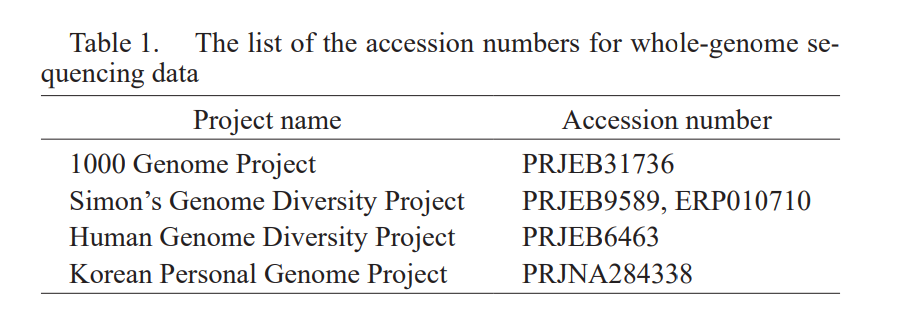
In a principalcomponent analysis (PCA) plot including a wide-range of Southeast, East, and Northeast Asian populations presented by Yang et al. (2020), two major genetic clines were observed: a south-to-north genetic cline and a Han-to-Tibetan genetic cline.
Note that we focus here on the East Asian populations and do not include Tibetan-related populations, because our primary dataset did not contain many Tibetanrelated individuals.
Establishment of Japanese populations
In this section, we summarize previous studies that help to elucidate the origin of people in the Japanese archipelago and present additional data analysis.
Origin of Jomon people
In recent years, several genomes of approximately 2500- to 4000-year-old Jomon samples have been successfully sequenced (Kanzawa-Kiriyama et al., 2017, 2019; McColl et al., 2018; Gakuhari et al., 2020). All of the studies agreed that the Jomon people represent a population deeply diverged from other East Asian populations and that Ainu people are more closely related to Jomon people than present-day mainland Japanese people are (Kanzawa-Kiriyama et al., 2019; Gakuhari et al., 2020).
The Jomon people also have broad genetic affinity to coastal populations of East Asia, such as aboriginal Taiwanese (Ami and Atayal), Korean, Nivkh, and Ulchi people (McColl et al., 2018; Kanzawa-Kiriyama et al., 2019; Gakuhari et al., 2020).
This pattern supports the hypothesis that the Jomon people entered the Japanese archipelago via a southern coastal route (Gakuhari et al., 2020), but is also consistent with admixture during the Neolithic (Jomon) period along the coastal regions of East Asia (Yang et al., 2020).
The strong affinity of Nivkh and Ulchi to Jomon can also be explained by more recent gene flow through Ainu (Gakuhari et al., 2020). Gakuhari et al. (2020) reported supportive evidence for the southern coastal route hypothesis in archeological remains and morphological traits.
Here we also present an interesting yet mysterious relationship between Jomon and Yana individuals.
We observed a marginally significant genetic similarity between Jomon and Yana individuals and between present-day Japanese and Yana individuals using f4 statistics; the f4(Yoruba, Yana; Jomon, Dai) value was –0.0144 (Z = –2.720)
ヤナ族
米国カリフォルニア(California)のサクラメント渓谷(Sacramento Valley)のピット川(Pit River)からロック?クリーク(Rock Creek)にかけて居住していたホカ語系の北米インディアン
This pattern could be explained by one of two scenarios.
First, similar to the population related to Tianyuan, an ancient population closely related to Jomon could have been involved in the ancient contact between the people migrating via the southern and northern routes.
田園洞人(英:Tianyuan man、拼音:TiányuándòngRén)は、2007年に中国北京近くの田園洞遺跡で発見された、古人骨
A second possibility is that a population more closely related to Yana than to Mal’ta migrated south during the LGM and admixed with the ancestral Jomon lineage only in the Japanese archipelago.
Although we currently do not have any genetic data that help to distinguish the likelihood of these two scenarios, it is difficult to imagine that descendants or populations closely related to Yana left the signature of admixture only to Jomon.
We should note that the deviation of f4 statistics showing the tie between Jomon and Yana was only marginally significant.
Origin of Yayoi people
The PCA plot in Figure 3 clearly shows that the presentday population genetically closest to the mainland Japanese is Korean.
Archeological evidence also supports the cultural similarity at the beginning of the Yayoi period (~1000 BCE) between the northern Kyusyu and the southwest Korean peninsula (Fujio, 2017).
An estimate of the split time between present-day mainland Japanese and Koreans using haplotype-phasing data mostly supports the hypothesis that the split occurred about 3000 years ago (Kim et al., 2020).
However, the time estimate needs to be interpreted carefully in general, because like all estimates based on genetic data, it depends on assumptions of average generation time and mutation/recombination rate in genomes.
When rice-farming was introduced to the northern Kyushu, the Korean peninsula was in the Mumun period, with a culture similar to the one in the northern Kyushu (Fujio, 2017).
ムムン陶器時代 - Mumun pottery periodWikipedia site:ja.janghan.net
無文土器時代は、韓国の先史時代の考古学時代であり、紀元前1500年から300年頃にさかのぼります。期間全体、特に紀元前850年から550年にかけて、陶器の集合体の大部分を形成する調理および保管容器。
【上はWikipedia site:ja.janghan.netという訳の分からんサイトより。多分、韓国人どもの国内サイトの機械翻訳内容である。
この2人こんなことよく知ってたな!長田氏は国籍はともかくDNAで見れば、朝鮮人又は混血かもしれない】
Studies of Y-chromosomal haplotypes revealed that the lineages of Y-chromosomal haplogroup O, which has the highest frequency in the mainland Japanese population, are also frequent in Korean and Southeast Asian populations (Hammer et al., 2006). The tie between Southeast Asia and Japan–Korea supports the hypothesis that rice-farming originated in the Yangtze River basin and was then introduced to the Korean peninsula and Japanese archipelago
We tested the hypothesis using available ancient and present-day genome data.
Ancient-genome data were obtained from the studies of Ning et al. (2020) and Yang et al. (2020). We evaluated whether present-day Japanese and Korean people are genetically similar to any of the Neolithic populations linked to the West Liao River basin, the Yellow River basin, and the Yangtze River basin.
. The f4 statistics showed that both present-day Japanese and Korean populations were genetically similar to the samples from the Early Neolithic Yellow River basin (Boshan) (Supplementary Table 5).
However, the statistical significance of the similarity to Boshan compared with CHB was marginal (|Z| = 2.47).
. On the other hand, we found Japanese–Korean were significantly more closely related to CHB than Neolithic southern Chinese individuals (Supplementary Table 5), indicating that the people in the Yangtze River basin did not substantially contribute to the genetic basis of present-day Japanese and Korean populations
. A parallel pattern to the f4 statistics is observed in the PCA plstatistics is observed in the PCA plot of Figure 3; the Early Neolithic Boshan and Bianbian individuals in the Lower Yellow River basin were plotted fairly close to present-day Korean individuals.
. Previous studies showed that the ancient samples from North China have more northern East Asian genetic components than the present-day Han Chinese.
The results suggest that the basal population of present-day Japanese and Korean people was somewhat different genetically to the Late Neolithic populations in the Yellow River and West Liao River basins.
If the dual-structure model generally holds, we would like to know how much Jomon ancestry the present-day mainland Japanese have. Previous studies proposed a wide range of Jomon ancestry fractions, from 9% to 45%, using different datasets, different models, and different assumptions (Horai et al., 1996; Nakagome et al., 2015; KanzawaKiriyama et al., 2017, 2019; McColl et al., 2018)
Yang et al. (2020) suggested the present-day Japanese are best modeled as an admixture between the Paleolithic northern East Asian individuals (Boshan) and Jomon individuals (Ikawazu) with the Jomon ancestry ratio being 0.38
We tested the model using the same source populations (Boshan and Ikawazu) but obtained a much smaller Jomon ancestry fraction (0.103 ± 0.030). The reason for the discrepancy is not clear, but it is likely because we used a different set of right (outgroup) populations to those used in the analysis by Yang et al. (2020).
When we assumed that the present-day Japanese population was an admixture of present-day Korean and Jomon populations (represented by F23), the estimated Jomon ancestry by qpAdm was 0.102 ± 0.005, slightly smaller than, but similar to, the values we obtained with the f4 ratio test.
韓国人どもと日本人を同じに扱っており、頭にきたので、ここ以降は読まず、あらゆる論文の主成分分析図が、韓国人と日本人は、遺伝的には、完全に別であり、綺麗に分岐していることを示している

コメント