Association between SNPs and gene expression in multiple regions of the human brain
nature Published: 08 May 2012S
Kim, H Cho, D Lee & M J Webster
In this study, we examined the association between genetic variations and gene expression in prefrontal cortex, hippocampus, temporal cortex, thalamus and cerebellum in subjects with psychiatric disorders and in normal controls.
The expression level of only one gene, PDE4DIP, was associated with a SNP, rs12124527, in all the brain regions tested here.
From our data, we generated a list of brain cis expression quantitative trait loci (eQTL) genes that we compared with a list of schizophrenia candidate genes downloaded from the Schizophrenia Forum (SZgene) database (http://www.szgene.org/).
Of the SZgene candidate genes, we found that the expression levels of four genes, HTR2A, PLXNA2, SRR and TCF4, were significantly associated with cis SNPs in at least one brain region tested. One gene, SRR, was also involved in a coexpression module that we found to be associated with disease status.
For instance, a web resource for schizophrenia, the Schizophrenia Forum (SZgene) database (http://www.szgene.org/), includes results from 1727 genetic association studies and reports 1008 candidate genes and 8788 polymorphisms in the update on 15 April 2011.6
First, we explore the candidate genes that may be functionally relevant for major psychiatric disorders by identifying cis associations between SNPs and gene expression in various brain tissues.
Second, we examine the possible functional role of schizophrenia candidate genes that were previously identified in genetic association studies.
We then examined whether the expression levels of any candidate genes from the SZgene database meta-analysis (http://www.szgene.org/) were regulated by cis expressed SNPs (eSNPs) in brain tissues, in order to determine if there were any functional effects on gene expression of the previously identified schizophrenia susceptibility genes.
Finally, we performed a coexpression network analysis between the genes in the frontal cortex that were differentially expressed between schizophrenia and normal controls and the cis eQTL genes in an attempt to identify the potential role of these genes in a disease-specific coexpression module.
The expression level of only one gene, phosphodiesterase 4D interacting protein (PDE4DIP), was associated with a SNP, rs12124527, in all the brain regions tested here. We then replicated the cis eQTLs of the frontal cortex using the larger AC collection.
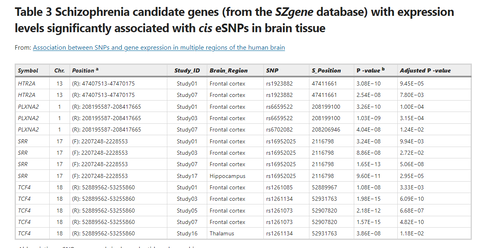
Among the 39 candidate genes, we found that the expression levels of four genes, HTR2A, PLXNA2, SRR and TCF4, were significantly associated with cis SNPs in at least one brain region tested (Table 3).
The expression levels of HR2A and PLXNA2 were associated with cis SNPs in the frontal cortex, whereas the expression levels of SRR (serine racemase) and TCF4 were associated with cis SNPs in two brain regions.
To further examine whether or not the four schizophrenia candidate genes (HTR2A, PLXNA2, SRR and TCF4) and genes of which expression levels were regulated by cis SNPs may be involved in the etiology of schizophrenia,
We were unable to construct a coexpression module that was significantly associated with schizophrenia disease status using the unsupervised analysis.
nature Published: 08 May 2012S
Kim, H Cho, D Lee & M J Webster
人の頭脳と関連する遺伝子候補としPDE4DIP,HTR2A=0, PLXNA2=90,SRR=0,and TCF4=147である。韓国人は、PDE4DIP遺伝子において、極めて大量の固有の変異を有している
My investigation of the relation between Koreans only variants by FDA paper (additional_file_7 xlsx) and mental disorder clearly indicates that Koreans carry the specific and peculiar mutation about PDE4DIP gene, and surprisingly, a number of Koreans inherent variants of PDE4DIP gene reaches 1374 (SNV-1 = expressed in FDA paper).
According to this paper, PDE4DIP gene is a crucial gene related to the human brain, and there is no awards winner of Koreans in all 60 over famous and international scientific prizes according to my investigation., including Nobel prize, Fields Medal and Boltzmann Award etc.
I investigated all 63 awards which are famous and international scientific prizes ,spending over 15 hours.
my effort should not end to efforts ! We Japanese people should know that Koreans carry crucial and very unique variants related human brain,
Maybe I have borned for spreading over the world and Japanese people that Koreans carry vast variants relating to the human brain, It is my destiny and appointed work by supernatural force.
Japanese people clearly are deceived by Koreans!
Abstract
In this study, we examined the association between genetic variations and gene expression in prefrontal cortex, hippocampus, temporal cortex, thalamus and cerebellum in subjects with psychiatric disorders and in normal controls.
The expression level of only one gene, PDE4DIP, was associated with a SNP, rs12124527, in all the brain regions tested here.
From our data, we generated a list of brain cis expression quantitative trait loci (eQTL) genes that we compared with a list of schizophrenia candidate genes downloaded from the Schizophrenia Forum (SZgene) database (http://www.szgene.org/).
Of the SZgene candidate genes, we found that the expression levels of four genes, HTR2A, PLXNA2, SRR and TCF4, were significantly associated with cis SNPs in at least one brain region tested. One gene, SRR, was also involved in a coexpression module that we found to be associated with disease status.
Introduction
For instance, a web resource for schizophrenia, the Schizophrenia Forum (SZgene) database (http://www.szgene.org/), includes results from 1727 genetic association studies and reports 1008 candidate genes and 8788 polymorphisms in the update on 15 April 2011.6
First, we explore the candidate genes that may be functionally relevant for major psychiatric disorders by identifying cis associations between SNPs and gene expression in various brain tissues.
Second, we examine the possible functional role of schizophrenia candidate genes that were previously identified in genetic association studies.
We then examined whether the expression levels of any candidate genes from the SZgene database meta-analysis (http://www.szgene.org/) were regulated by cis expressed SNPs (eSNPs) in brain tissues, in order to determine if there were any functional effects on gene expression of the previously identified schizophrenia susceptibility genes.
Finally, we performed a coexpression network analysis between the genes in the frontal cortex that were differentially expressed between schizophrenia and normal controls and the cis eQTL genes in an attempt to identify the potential role of these genes in a disease-specific coexpression module.
Materials and methods
Gene expression microarray data from frontal cortex,13 cerebellum, thalamus and temporal cortex14were generated by multiple independent groups using samples from the SNC (N=60), which contains 15 well-matched cases in each of four groups: schizophrenia, bipolar disorder, major depression and unaffected controls.15Results
The expression level of only one gene, phosphodiesterase 4D interacting protein (PDE4DIP), was associated with a SNP, rs12124527, in all the brain regions tested here. We then replicated the cis eQTLs of the frontal cortex using the larger AC collection.
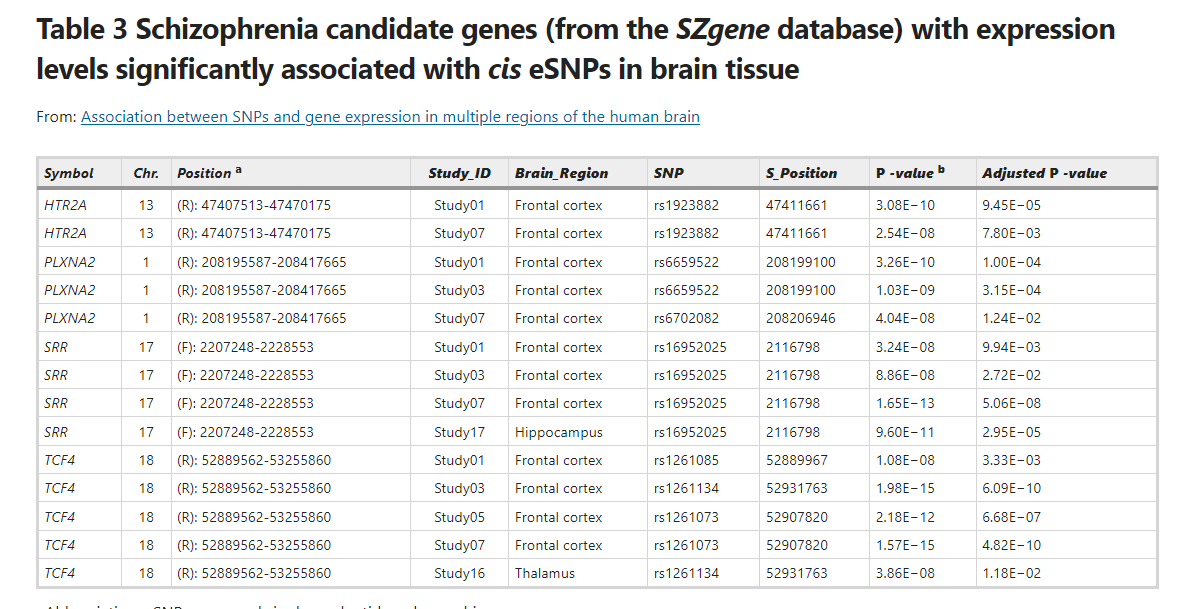
Among the 39 candidate genes, we found that the expression levels of four genes, HTR2A, PLXNA2, SRR and TCF4, were significantly associated with cis SNPs in at least one brain region tested (Table 3).
The expression levels of HR2A and PLXNA2 were associated with cis SNPs in the frontal cortex, whereas the expression levels of SRR (serine racemase) and TCF4 were associated with cis SNPs in two brain regions.
To further examine whether or not the four schizophrenia candidate genes (HTR2A, PLXNA2, SRR and TCF4) and genes of which expression levels were regulated by cis SNPs may be involved in the etiology of schizophrenia,
Discussion
The expression of one gene, PDE4DIP, was associated with one SNP, rs12124527, in all brain regions examined. This association was also previously described in the frontal cortex.20 The protein encoded by PDE4DIP serves to anchor phosphodiesterase 4D to the Golgi/centrosome region of the cell.We were unable to construct a coexpression module that was significantly associated with schizophrenia disease status using the unsupervised analysis.

コメント