High level of inbreeding in final phase of 1000 Genomes Project
Nature Published: 02 December 2015
Steven Gazal et al.
The last release of this project includes more than 2,500 sequenced individuals from 26 populations.Although relationships among individuals have been investigated in some of the populations, inbreeding has never been studied
In this article, we estimated the genomic inbreeding coefficient of each individual and found an unexpected high level of inbreeding in 1000 Genomes data:
nearly a quarter of the individuals were inbred and around 4% of them had inbreeding coefficients similar or greater than the ones expected for first-cousin offspring.
As we already reported inbreeding in HapMap phase III individuals10, some of whom are included in the TGP, we thus might expect inbreeding in this panel.
We applied our FSuite pipeline11, which estimates the genomic inbreeding coefficient f of individuals from their genotype data and calculates the probability to be offspring of different mating types in order to infer the most likely relationship of the parents.
【FSuiteというのがあるのを知った】
The genome of an inbred individual is characterized by large regions homozygous-by-descent (HBD), i.e. regions where this individual has inherited two haplotypes identical-by-descent from a common ancestor. The genomic inbreeding coefficient f of an individual can thus be defined as the proportion of the genome that is HBD.
First are single-point methods that rely only on the allele frequencies at each marker. Second are multi-point methods that use both allele frequencies and the fact that HBD genotypes come in blocks.
Our pipeline FSuite is a multi-point method, which requires the markers to be in minimal linkage disequilibrium (LD). FSuite therefore creates multiple random sparse marker maps (submaps) to minimize LD of the data while providing robust f estimations. Here, we ran FSuite on 100 submaps by selecting several random markers in each genomic regions delimited by recombination hotspots. This strategy optimizes the f estimation accuracy and the detection of inbred individuals10.
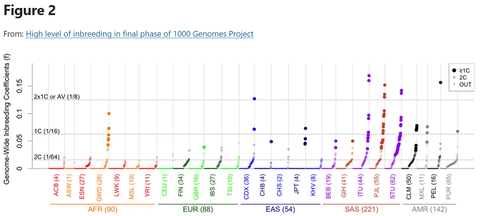
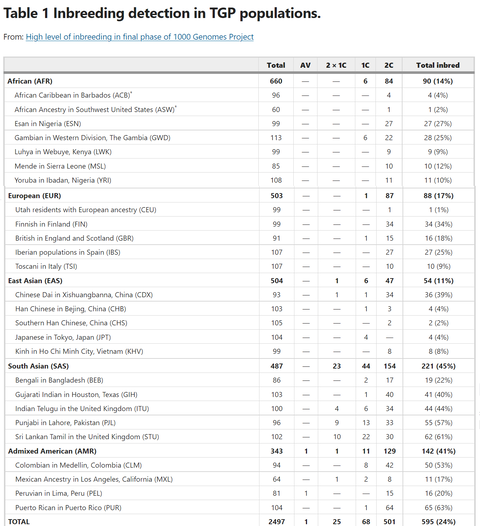
Most (501) of the 595 inbred individuals were inferred as 2C offspring and can be considered as descending from remote inbreeding. On the opposite, 94 individuals can be considered as descending from recent inbreeding, i.e. being offspring of first-cousin or closest relationships.
Three-quarters of the inbred individuals came from 4 populations: ITU (10), PJL (22), STU (32) and CLM (8). Finally, note that GIH and PUR populations, that had a high proportion of inbred individuals (40% and 64%, respectively), had only one individual who exhibited recent inbreeding.
Of interest, the most inbred European population is the Finnish with one third of individuals detected as remote inbreeding (34% as 2C and maximum f equals to 0.035). This is in accordance with the population history of the Finns: a small number of founders and very little immigration19.
Nature Published: 02 December 2015
Steven Gazal et al.
nearly a quarter of the individuals were inbred and around 4% of them had inbreeding coefficients similar or greater than the ones expected for first-cousin offspring.
Inbred individuals were found in each of the 26 populations, with some populations showing proportions of inbred individuals above 50%.
インド・パキスタンでは、近交系数が高いことは知ってはいたが、論文冒頭の要約中の上記には驚いた
The last release of this project includes more than 2,500 sequenced individuals from 26 populations.Although relationships among individuals have been investigated in some of the populations, inbreeding has never been studied
In this article, we estimated the genomic inbreeding coefficient of each individual and found an unexpected high level of inbreeding in 1000 Genomes data:
nearly a quarter of the individuals were inbred and around 4% of them had inbreeding coefficients similar or greater than the ones expected for first-cousin offspring.
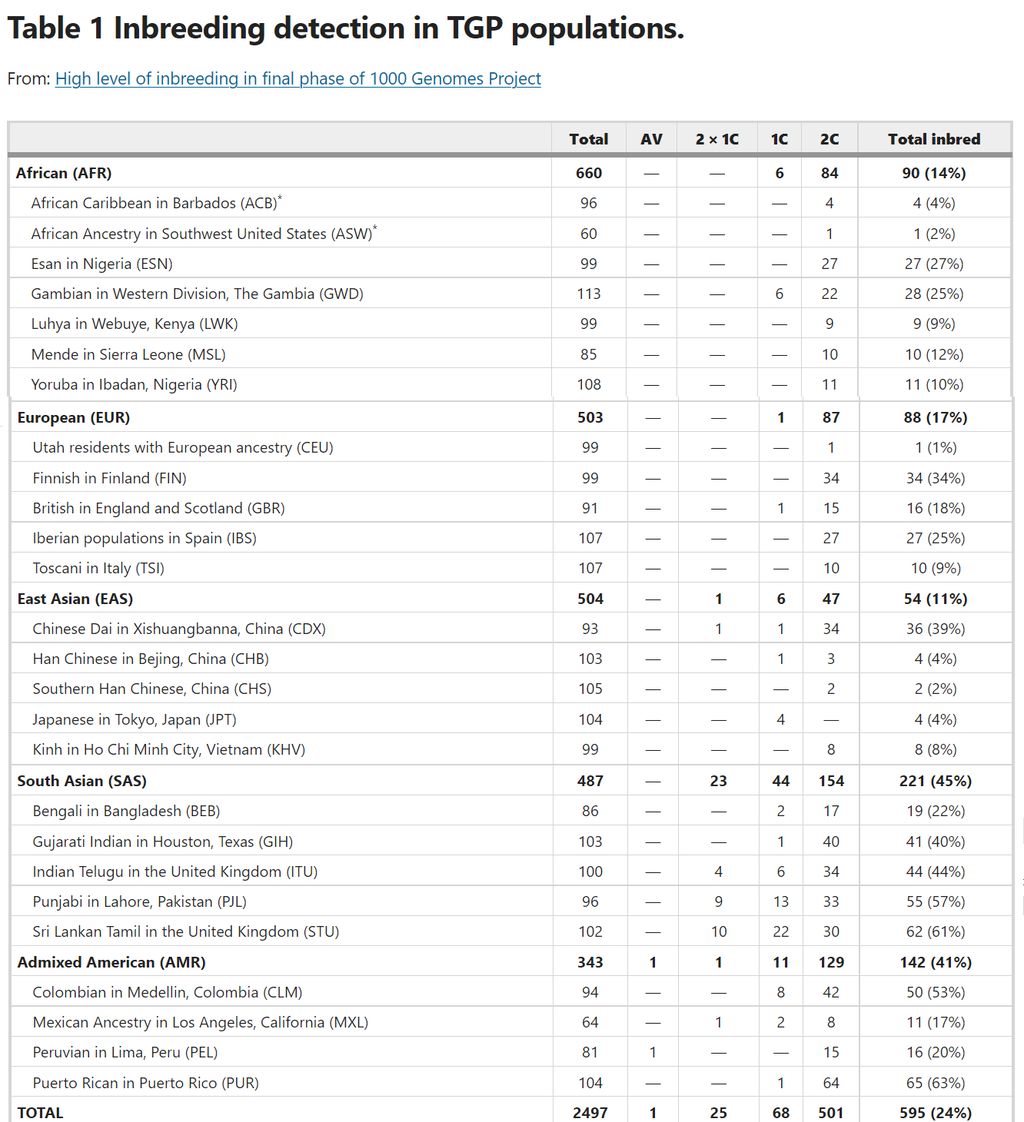
- 1 ASW, 2 ITU and 4 PEL of the 2,504 initial individuals have been removed due to Q-score ≤ 50. AV = avuncular offspring; 2 × 1C = double first-cousin offspring; 1C = first-cousin offspring; 2C = second-cousin offspring.
- *These populations should be considered as Admixed African.
As we already reported inbreeding in HapMap phase III individuals10, some of whom are included in the TGP, we thus might expect inbreeding in this panel.
We applied our FSuite pipeline11, which estimates the genomic inbreeding coefficient f of individuals from their genotype data and calculates the probability to be offspring of different mating types in order to infer the most likely relationship of the parents.
【FSuiteというのがあるのを知った】
The genome of an inbred individual is characterized by large regions homozygous-by-descent (HBD), i.e. regions where this individual has inherited two haplotypes identical-by-descent from a common ancestor. The genomic inbreeding coefficient f of an individual can thus be defined as the proportion of the genome that is HBD.
First are single-point methods that rely only on the allele frequencies at each marker. Second are multi-point methods that use both allele frequencies and the fact that HBD genotypes come in blocks.
Our pipeline FSuite is a multi-point method, which requires the markers to be in minimal linkage disequilibrium (LD). FSuite therefore creates multiple random sparse marker maps (submaps) to minimize LD of the data while providing robust f estimations. Here, we ran FSuite on 100 submaps by selecting several random markers in each genomic regions delimited by recombination hotspots. This strategy optimizes the f estimation accuracy and the detection of inbred individuals10.
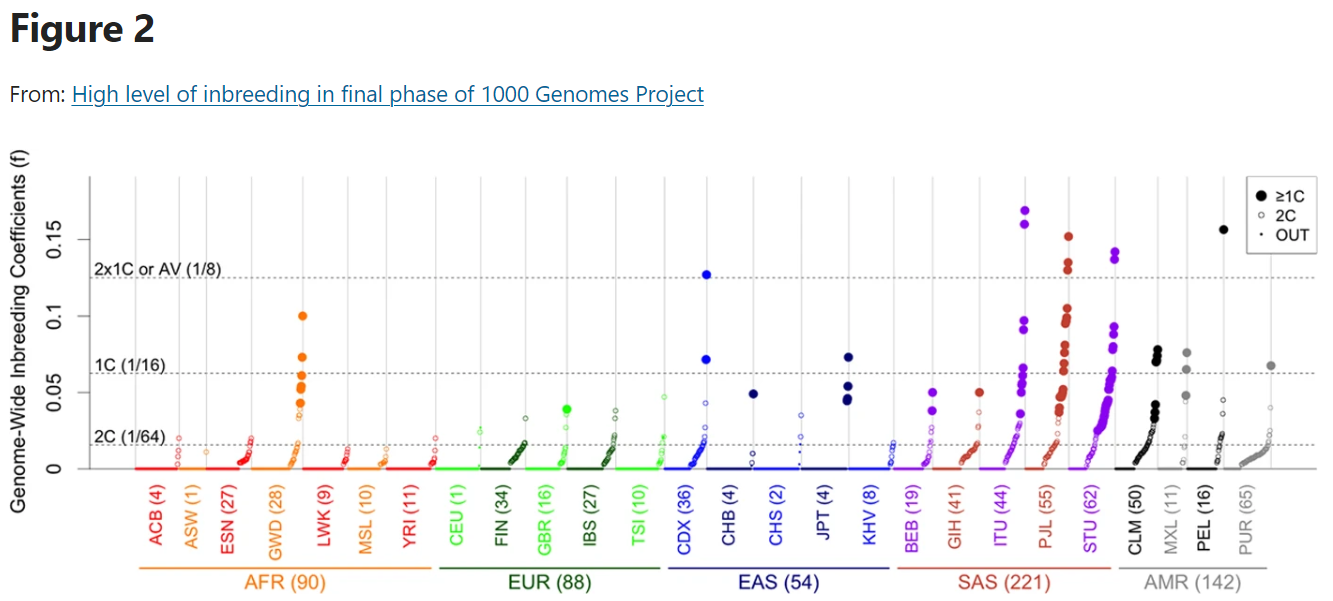
Inbreeding estimation and detection in TGP populations.
Each point represents the f estimate for one individual. Large points represent the ones that are inferred as offspring of first-cousin (1C) or closest relationships, medium open points, the ones that are inferred as offspring of second-cousin offspring (2C) and small points, the ones that are inferred as outbred. Individuals were ordered in each population according to their f values. See Table 1 for the description of the different populations.
Most (501) of the 595 inbred individuals were inferred as 2C offspring and can be considered as descending from remote inbreeding. On the opposite, 94 individuals can be considered as descending from recent inbreeding, i.e. being offspring of first-cousin or closest relationships.
Three-quarters of the inbred individuals came from 4 populations: ITU (10), PJL (22), STU (32) and CLM (8). Finally, note that GIH and PUR populations, that had a high proportion of inbred individuals (40% and 64%, respectively), had only one individual who exhibited recent inbreeding.
Of interest, the most inbred European population is the Finnish with one third of individuals detected as remote inbreeding (34% as 2C and maximum f equals to 0.035). This is in accordance with the population history of the Finns: a small number of founders and very little immigration19.

コメント