Diverse northern Asian and Jomon-related genetic structurediscovered among socially complex Three Kingdoms periodGaya region Koreans
Pere Gelabert et.al
October 25, 2021
Abstract
All eight individuals are from the Korean Three Kingdoms period (4th-7th century CE), during which there is archaeological evidence of extensive trade connections with both northern (modern-day China) and eastern (modern-day Japan) kingdoms.
All genomes are best modeled as an admixture between a northern-Chinese Iron Age genetic source and a Japanese-Jomon-related ancestry.
The proportion of Jomon-related ancestry suggests the presence of two genetic groups within the population.
The observed substructure indicates diversity among the Gaya population that is not related to either social status or sex.
Introduction
Present-day Koreans are an East Asian group with distinct genetic and linguistic traits.
A recent study of 1,094 present-day Korean genomes indicates that they are a genetically homogenous group (10).
This apparent homogeneity may be the outcome of isolation during the last centuries due to genetic drift.
Additionally, Korean maternal and paternal markers hint towards multiple lineages forming the present-day Korean population through admixture events in the past (10, 11).
Both the genetic study of rice (12) and archeological research(13) suggest that rice, and crops including millet and various legumes, were introduced and subsequently intensively used in the Korean peninsula around 850-550 BCE (13).
Up to this day, the exact location from where the rice was introduced in the Korean peninsula is controversial, however, there is a consensus that rice cultivation spread from the Korean peninsula to the Japanese archipelago (14).
After agriculture, iron production arrived from China to Korea around the 4th century BCE (15, 16), and further spread from Korea to Japan during the Yayoi period (10th century BCE-3rd century CE) (17).
Results
We screened 27 petrous bones and teeth obtained from 22 individuals from two archeological sites in Gimhae city, Gyeongsangnam-do
the Daeseong-dong and Yuha-ri, both dated to 4th–5th century CE.
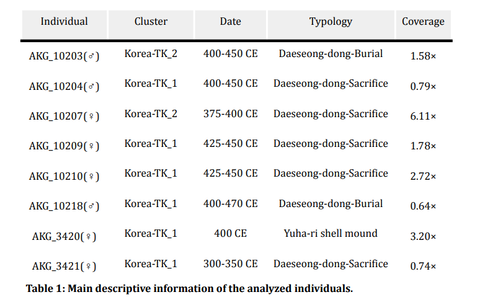
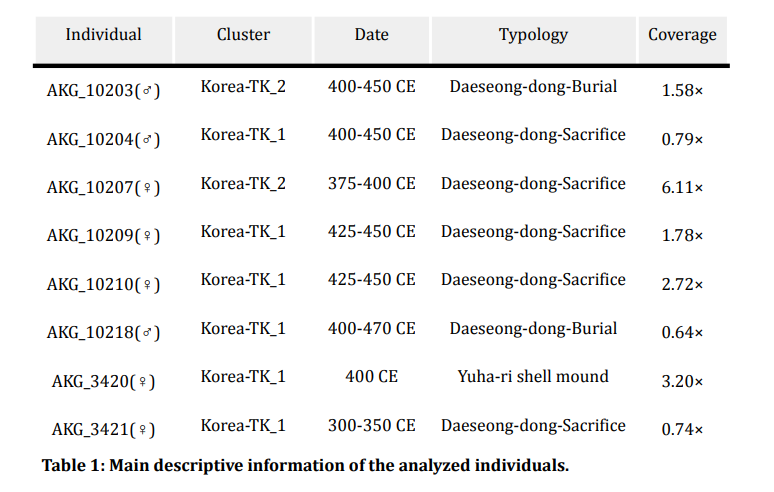
he libraries of eight individuals had over 7% of sequencing reads aligning to the human reference genome (range from 7.3% to 68.9% (Table S1)). The sequencing yielded coverage depths between 0.7× and 6.1× (Table 1). All seven Daeseong-dong individuals were associated with specific mortuary practices which are linked to social status, specifically, main burials, and human sacrifices.
Uniparental markers
All the samples have typical East Asian mitochondrial DNA (mtDNA) haplogroups (Table S3) : D (n=5), B, F, and M when we determined the haplogroups from the consensus sequences obtained from Schmutzi (27) with HaploGrep2 (28).
The most common Korean mtDNA haplogroup is D4, which we identified in four of the individuals. This haplogroup is also common among Japanese Yayoi farmers, while absent in Jomon (29).
The third male, AKG_10218, ecould not offer fine resolution, but was nonetheless able to be assigned an O haplogroup.
Population genetics based on Principal Component Analysis, qpWave, and ADMIXTURE
We focused on the Human Origins (HO) (31) panel of SNPs and compared those for the eight genomes with the rest of East Asian modern and ancient diversity.
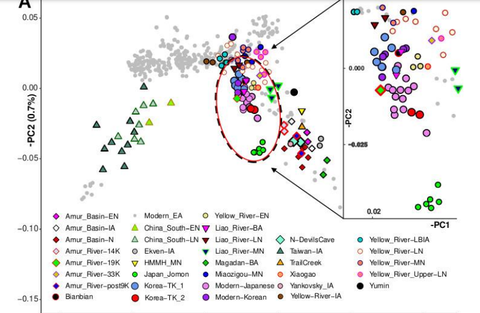
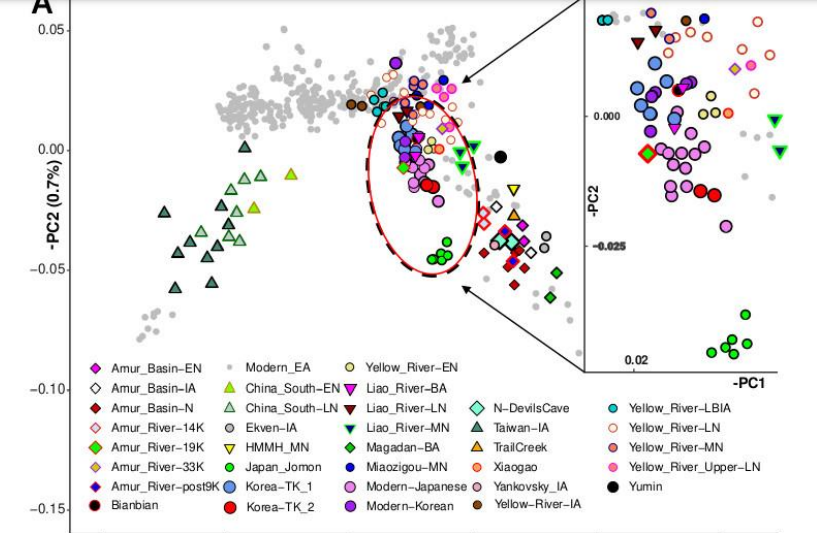
A Principal Component Analysis (PCA) performed with smartPCA showed the presence of three differentiated genetic groups in ancient East-Asia: 1) the Amur River populations, 2) northern China, and 3) southern China and Taiwanese populations (Fig. 2A, Fig. S6, Table S4-S5).
The eight individuals from the TK fall clearly within the diversity of the East Asian samples, especially present-day Koreans and Japanese (Fig. 2A).
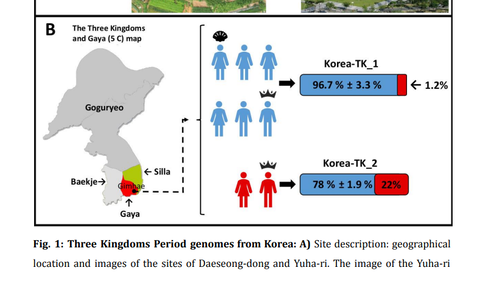
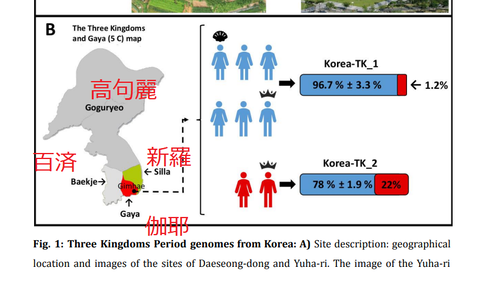
B) Genomic composition of the AKG individuals: We present the eight individuals classified into the two identified genetic groups based on qpAdm analyses: TK_1 (blue icon), and TK_2 (red icon), the percentage bar graph shows the genetic ancestry proportions of: North-China Iron Age ancestry (blue), Jomon-related ancestry (red). Individuals in panel B are also classified by the archeological context. Crown depicts a main burial, and a shell depicts the shell mound burial, the samples without a distinct marking are human sacrifices.
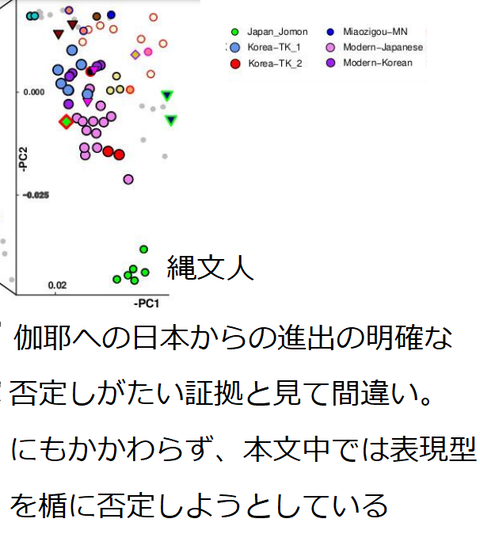
However, two samples (AKG_10203 and AKG_10207), clustered rather closely with present-day Japanese and closer to Japanese Jomon individuals (Fig. 2A), a pattern which distinguishes them from the other six individuals which cluster with present-day Koreans.
Next, we further explored the ancestral compositions of the eight individuals using a pairwise qpWave analysis.
When using a set of ten outgroup populations, which includes ancient Japanese Jomon populations, most individuals formed a clade with each other.
We further explored the genetic structure of the Gimhae Korean individuals with ADMIXTURE analysis, which included 2,283 present-day and ancient individuals (Fig. 2B, Fig. S8) and a pruned SNP set of the Human Origin (HO) dataset (extended methods).
At K=9, the Korea-TK individuals could be represented by two major genetic components shared with the Neolithic Devils_Gate (Russian Far East) genomes (Fig. 2B). One is mainly characteristic of Siberian Late Neolithic genomes (light purple), and the other is a major genetic component that is commonly present in most ancient and present-day East Asians, and is especially characteristic of ancient southern Chinese, southeast Asians, and modern Kinh Vietnamese (orange).
However, in contrast, the two aforementioned individuals, AKG_10203 and AKG_10207, formed a clade only with each other, which is related to their shared Jomon-related ancestry
The origin of the Korean Three Kingdoms Period population using f-statistics
We computed outgroup f3 statistics, which measures the amount of shared genetic similarity between populations.
When compared to various present-day Asian populations, present-day Koreans and Han Chinese were the closest groups to Korea-TK_1 while the Japanese were the closest group to Korea-TK_2 (Fig. 3A-3B, Table S6).
Genetic and phenotypic continuity
The results obtained with fineSTRUCTURE and identity-by-descent (IBD) analyses, which were based on the imputed genotypes (see Methods), both show a clear separation between Korea-TK_1 and Korea-TK_2 groups.
FineSTRUCTURE suggested Korea-TK_1 individuals were equally related to present-day Koreans and Japanese, a result which was also supported by the higher number and length of IBD blocks that each of the Korea-TK_1 individuals shared with these populations.
In regards to Korea-TK_2, the individuals have close genetic affinity to present-day Japanese and the Japanese Jomon from Ikawasu IK002 (Fig. 4A, 4B, Table S13-S14). When compared to the other Korea-TK_1 individuals, the Korea-TK_2 individuals also have a longer length and a higher frequency of shared IBD blocks with present-day Japanese (Fig. 4C).
Using a commercial individual-based ancestry prediction service (https://parabon-nanolabs.com), we confirmed that the genetic profile of Korea-TK_1 provides the best match for present-day Korean ancestry while for Korea-TK_2 individuals the closest match was the Japanese Ryukyuan people.
. Interestingly, the pairwise IBD sharing based on pseudo haploid calls confirmed the absence of close familial relationship among the individuals. However, the two TK2 individuals appeared to share significantly (at least twice) more IBD with each other compared to any other pairing (Fig. 5C).
Based on our eight samples, we conclude that all of the relevant variants present in the modern Korean population were already established in the TK period at least 1,700 years ago, showing a deep genetic continuity (Table S15).
Some East Asian traits were detected among all the analyzed individuals including dry earwax, no body odor (SNP rs17822931) (33), lactose intolerance (rs4988235) (34), and no homozygous alleles associated with excess sweating (35). All these traits are also common among present-day Koreans.
Surprisingly, the genetic makeup of the eight Gaya Korean samples also reflected common present-day Korean healthcare and aesthetic concerns: all individuals have multiple (four or more) ‘susceptibility-to-myopia-risk’ alleles. Myopia is highly prevalent in Korea, reaching values of 95% in adult males from Seoul (38).
Discussion
The genetic diversity seen among the Gimhae TK period individuals can be explained by at least two scenarios. One is that the Jomon ancestry observed in Korea-TK_2 is the result of a regional admixture that occurred gradually within the Korean peninsula between at least two subpopulations where the indigenous population already carried the genomic components prominent among Jomon people. There is indeed some evidence of Jomon existence in the Korean peninsula along the Southeastern coastline supported by the artefacts such as pottery and obsidian arrowheads. The obsidian is recognized as an import from Kyushu in Japan (43), however such evidence dates to the Neolithic (10000-1500
BCE), a rather distant history. Moreover, Jomon has not been identified as a dominant cultural component in this area, which could imply that individuals bearing Jomon-related ancestry were either completely absorbed by populations originating from northern China, who entered along the Korean peninsula coastlines, or their genetic signal was diluted by various other demographic scenarios, leading to the genetic homogeneity observed in present-day Koreans.
Under this scenario, it is possible that the reported DATES result of an admixture event eight generations before the current samples, also can be associated with the admixtures that lead to this dilution.
The second scenario is that the population of the Gaya region was diverse and some level of cosmopolitanism prevailed in relation to intense trade and connections with nowadays Japan, similar recently reported results for Iron Age and Antiquity period populations in the case of Rome and neighboring port cities (23). Human movements and admixture are closely related to trading networks and connections between geographic populations in these regions. Archeological studies suggest that the Japanese Yayoi culture received a populational input from the Korean peninsula in a form of populations who crossed the narrow Korean Strait between Busan/Gimhae and Kyushu/Honshu islands (44–46) which in some cases may complicate the genetic and cultural differentiation between ancient Koreans and Japanese.
Taking into consideration the limitations of the current data, it is difficult to conclusively determine whether the Jomon component in Gimhae samples is derived mainly from local Korean or external Japanese sources. Based on the DATES analysis for the Korea-TK_2 individuals, the admixture with the Jomon component could have occurred around 200 CE, which overlaps with the reign of Gaya, if we assume that there were distinct Jomon-like and non-Jomon-like populations in the region.
There is archeological evidence of multiple subgroups within the broadly referred Jomon people rather than a single homogeneous population. This partially explains why AKG_10203 can only be modelled with the Jomon genome from Ikawazu (897-803 cal BC) (5) but not with the genomes from Rokutsu shell Mound (2472-835 cal BC) (47).
The differences between the dates and geographical locations (Ikawazu genome is from Honshu, Japan’s main island, which is geographically associated with Korea along the well-established Setonaikai coastal route) also highlights the need to consider possible Jomon heterogeneity when interpreting admixture. This however, could also be the result of technical limitations of the method itself due to the low sample numbers.
We demonstrated that the people of the TK period in Gaya were more genetically diverse than present-day Koreans, and that they had diverse ancestral components and population substructure that have been homogenizing from the TK period onwards.
The phenotypic analysis confirmed that over 100 forensically-relevant SNPs of present-day Koreans were already established during the TK period.
Pere Gelabert et.al
October 25, 2021
筆頭著者Pere Gelabertは、所属を見るとオーストリア人のようである
1 Department of Evolutionary Anthropology, Djerassiplatz 1, 1030 Vienna, University of Vienna, Vienna, Austria
その他ポルトガル人等が韓国人という精神面での完全なDNA異常民族以外の著者である。
FDA論文にはキチガイどもが一人も共著者に含まれれおらず事実上は完全にFDAの毒物研究センターによって書かれた論文であるのに対し(=このこと自体がまさに異例中の異例であり、通常は考えられないが)、この論文には、韓国人どもも名を連ねている。
分析自体は古代人DNA分析方法を知らない韓国人ども以外の者によってされたと考えて100%間違いない
日本人の二重構造モデルとの関連らからしても、あまりにも重要な論文であり、私の知る限り、13世紀のモンゴル軍侵攻前の朝鮮半島の当時は精神面で正常なDNAを有していた人々のDNAに関する初の分析である。これ以外には、韓国人どもによるDNA分析による韓国人起源分析論文2021年02月01日(メモ済み)があるが、箸にも棒にもかからんくだらん内容であった
冒頭の要約中の
All genomes are best modeled as an admixture between a northern-Chinese Iron Age genetic source and a Japanese-Jomon-related ancestry.
は、決定的に重要であり、4-7世紀の朝鮮半島の人々と現在の韓国人が遺伝的に見れば、大きく変化していることの証ととれる。この冒頭の要約のみ筆頭著者の手による可能性が高い。
しかし、本文中では概ね逆に否定しようとしており、Pere Gelabertが文章作成にかかわったのは、要約部分のみであろうと推定される
現代韓国人を分析した場合には、主成分分析図、Fst遺伝距離算出のいずれでも、どの論文でも、二重構造モデルと異なり、韓国人という完全な精神面でのDNA異常民族にに最も近いのは日本人ではなく北方系中国人であるという結論となっているが、13世紀にモンゴル侵攻によるボトルネック効果の表れと見て間違いない。
恐らくは、13世紀に30年以上に及ぶモンゴルへの高麗の抵抗(その裏には確実に南宋の指示がある)と1257~1259年にかけて生じた火山噴火(1257年)による一時的な寒冷化の重なりが、想像を絶する飢饉を朝鮮半島に招き、私が、兵力数から推定した85%程度の人口減少どころではなく、紀伝体で書かれた高麗史李蔵用伝に明確に書かれているように90%~95%以上の人口減少があった可能性すら否定しえない。私は、従来は高麗史李蔵用伝は大げさに書いているだけだ!と考えてきたが、この論文からすると、高麗史李蔵用伝の記述は真実に近い可能性が高い
この論文自体は、形質・表現型を中心に、遺伝的な継続性を異常なほど本文中で強調している。
しかし、2個体については、主成分分析図では現代日本人よりも更に縄文人近くにプロットされており、どこからどう見ても、伽耶に住んでいた当時の日本人又は日本人と全く変わらないDNAを有する当時の朝鮮半島人である。サンプル数は少ないが、中国史の一部とみなすべき=中国史の地方史である朝鮮半島史に決定的な影響を及ぼす可能性が高い。中国人・日本人歴史学者がこの論文の重要性に気づけばの話ではあるが・・・?
Abstract
All eight individuals are from the Korean Three Kingdoms period (4th-7th century CE), during which there is archaeological evidence of extensive trade connections with both northern (modern-day China) and eastern (modern-day Japan) kingdoms.
All genomes are best modeled as an admixture between a northern-Chinese Iron Age genetic source and a Japanese-Jomon-related ancestry.
The proportion of Jomon-related ancestry suggests the presence of two genetic groups within the population.
一見そのとおりであるが、SNPの主成分分析図では、どの論文でも、現代のキチガイどもに上記の2グループの存在は見られない。即ち、伽耶に進出していた当時の日本人である。外国人著者らは、introduction 作成には加わっていないと考えて間違いない。introduction の英文はオーストラリア人が書いたものでは明らかになく、韓国人が書いたので間違いない。筆頭著者のPere Gelabertは、まだ若いようであるが、古代人DNA抽出の専門家のようである。いくつかの国で古代人DNA分析している。なんのことはない、韓国人どもはバカだからコンタミを恐れて自分たちではDNA抽出できず、Pere Gelabert他の経験と実績のある外国人にDNA抽出を依頼したのだ
The observed substructure indicates diversity among the Gaya population that is not related to either social status or sex.
Introduction
Present-day Koreans are an East Asian group with distinct genetic and linguistic traits.
A recent study of 1,094 present-day Korean genomes indicates that they are a genetically homogenous group (10).
This apparent homogeneity may be the outcome of isolation during the last centuries due to genetic drift.
Additionally, Korean maternal and paternal markers hint towards multiple lineages forming the present-day Korean population through admixture events in the past (10, 11).
Both the genetic study of rice (12) and archeological research(13) suggest that rice, and crops including millet and various legumes, were introduced and subsequently intensively used in the Korean peninsula around 850-550 BCE (13).
朝鮮半島での稲作開始が850-550 BCEが正しければ、日本より遅れて又はほぼ同時に稲作が始まったことになるよ、大爆笑。この辺りの記述は、英文のヘタクソからみて明らかにアホな韓国人どもが書いたことが分かるので無理もないが
Up to this day, the exact location from where the rice was introduced in the Korean peninsula is controversial, however, there is a consensus that rice cultivation spread from the Korean peninsula to the Japanese archipelago (14).
After agriculture, iron production arrived from China to Korea around the 4th century BCE (15, 16), and further spread from Korea to Japan during the Yayoi period (10th century BCE-3rd century CE) (17).
Results
We screened 27 petrous bones and teeth obtained from 22 individuals from two archeological sites in Gimhae city, Gyeongsangnam-do
the Daeseong-dong and Yuha-ri, both dated to 4th–5th century CE.
he libraries of eight individuals had over 7% of sequencing reads aligning to the human reference genome (range from 7.3% to 68.9% (Table S1)). The sequencing yielded coverage depths between 0.7× and 6.1× (Table 1). All seven Daeseong-dong individuals were associated with specific mortuary practices which are linked to social status, specifically, main burials, and human sacrifices.
Uniparental markers
All the samples have typical East Asian mitochondrial DNA (mtDNA) haplogroups (Table S3) : D (n=5), B, F, and M when we determined the haplogroups from the consensus sequences obtained from Schmutzi (27) with HaploGrep2 (28).
The most common Korean mtDNA haplogroup is D4, which we identified in four of the individuals. This haplogroup is also common among Japanese Yayoi farmers, while absent in Jomon (29).
The third male, AKG_10218, ecould not offer fine resolution, but was nonetheless able to be assigned an O haplogroup.
Population genetics based on Principal Component Analysis, qpWave, and ADMIXTURE
We focused on the Human Origins (HO) (31) panel of SNPs and compared those for the eight genomes with the rest of East Asian modern and ancient diversity.
A Principal Component Analysis (PCA) performed with smartPCA showed the presence of three differentiated genetic groups in ancient East-Asia: 1) the Amur River populations, 2) northern China, and 3) southern China and Taiwanese populations (Fig. 2A, Fig. S6, Table S4-S5).
The eight individuals from the TK fall clearly within the diversity of the East Asian samples, especially present-day Koreans and Japanese (Fig. 2A).
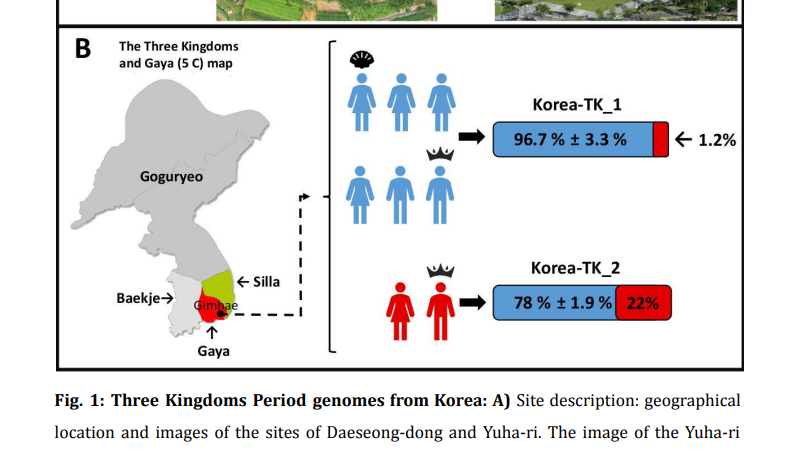
B) Genomic composition of the AKG individuals: We present the eight individuals classified into the two identified genetic groups based on qpAdm analyses: TK_1 (blue icon), and TK_2 (red icon), the percentage bar graph shows the genetic ancestry proportions of: North-China Iron Age ancestry (blue), Jomon-related ancestry (red). Individuals in panel B are also classified by the archeological context. Crown depicts a main burial, and a shell depicts the shell mound burial, the samples without a distinct marking are human sacrifices.
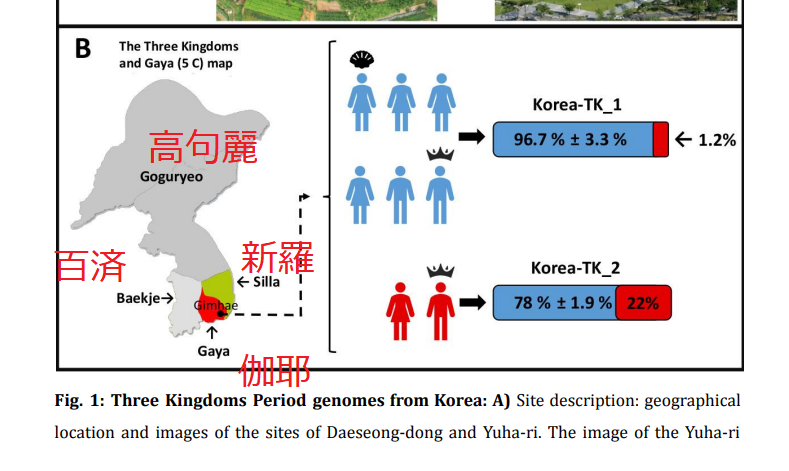
上の図の通りであり、サンプルは伽耶である。従って、当時の日本人が進出していたとされる地域である
However, two samples (AKG_10203 and AKG_10207), clustered rather closely with present-day Japanese and closer to Japanese Jomon individuals (Fig. 2A), a pattern which distinguishes them from the other six individuals which cluster with present-day Koreans.
決定的な証拠が出たと考えてよい。この2体のような個体は、現代韓国人=キチガイどもには全く存在しない
Next, we further explored the ancestral compositions of the eight individuals using a pairwise qpWave analysis.
赤字のように8個体のみ対象としている
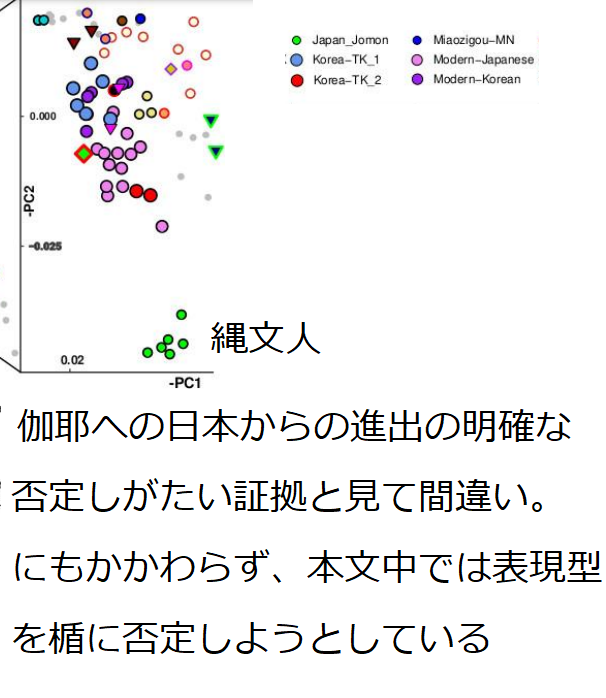
サンプル数は少ないが、朝鮮半島に伽耶が存在していた当時から既に日本人と当時は正常であったであろう朝鮮半島の人々は遺伝的には分岐している。赤丸2名は間違いなく日本人DNAである。
その後の13世紀のモンゴル軍侵攻によるボトルネック効果を経て、現代韓国人が形成された。現在よりも、はるかに近い位置に当時の朝鮮人がプロットされている
When using a set of ten outgroup populations, which includes ancient Japanese Jomon populations, most individuals formed a clade with each other.
We further explored the genetic structure of the Gimhae Korean individuals with ADMIXTURE analysis, which included 2,283 present-day and ancient individuals (Fig. 2B, Fig. S8) and a pruned SNP set of the Human Origin (HO) dataset (extended methods).
At K=9, the Korea-TK individuals could be represented by two major genetic components shared with the Neolithic Devils_Gate (Russian Far East) genomes (Fig. 2B). One is mainly characteristic of Siberian Late Neolithic genomes (light purple), and the other is a major genetic component that is commonly present in most ancient and present-day East Asians, and is especially characteristic of ancient southern Chinese, southeast Asians, and modern Kinh Vietnamese (orange).
However, in contrast, the two aforementioned individuals, AKG_10203 and AKG_10207, formed a clade only with each other, which is related to their shared Jomon-related ancestry
The origin of the Korean Three Kingdoms Period population using f-statistics
We computed outgroup f3 statistics, which measures the amount of shared genetic similarity between populations.
When compared to various present-day Asian populations, present-day Koreans and Han Chinese were the closest groups to Korea-TK_1 while the Japanese were the closest group to Korea-TK_2 (Fig. 3A-3B, Table S6).
Genetic and phenotypic continuity
The results obtained with fineSTRUCTURE and identity-by-descent (IBD) analyses, which were based on the imputed genotypes (see Methods), both show a clear separation between Korea-TK_1 and Korea-TK_2 groups.
FineSTRUCTURE suggested Korea-TK_1 individuals were equally related to present-day Koreans and Japanese, a result which was also supported by the higher number and length of IBD blocks that each of the Korea-TK_1 individuals shared with these populations.
In regards to Korea-TK_2, the individuals have close genetic affinity to present-day Japanese and the Japanese Jomon from Ikawasu IK002 (Fig. 4A, 4B, Table S13-S14). When compared to the other Korea-TK_1 individuals, the Korea-TK_2 individuals also have a longer length and a higher frequency of shared IBD blocks with present-day Japanese (Fig. 4C).
Using a commercial individual-based ancestry prediction service (https://parabon-nanolabs.com), we confirmed that the genetic profile of Korea-TK_1 provides the best match for present-day Korean ancestry while for Korea-TK_2 individuals the closest match was the Japanese Ryukyuan people.
こいつらアホか、大爆笑。遺伝学論文で民間会社の先祖探しを論拠の一つにしている論文なんぞありうるのか?
. Interestingly, the pairwise IBD sharing based on pseudo haploid calls confirmed the absence of close familial relationship among the individuals. However, the two TK2 individuals appeared to share significantly (at least twice) more IBD with each other compared to any other pairing (Fig. 5C).
Based on our eight samples, we conclude that all of the relevant variants present in the modern Korean population were already established in the TK period at least 1,700 years ago, showing a deep genetic continuity (Table S15).
何故こう言えるかと言えば、下の通りであるが、話にならん
Some East Asian traits were detected among all the analyzed individuals including dry earwax, no body odor (SNP rs17822931) (33), lactose intolerance (rs4988235) (34), and no homozygous alleles associated with excess sweating (35). All these traits are also common among present-day Koreans.
Surprisingly, the genetic makeup of the eight Gaya Korean samples also reflected common present-day Korean healthcare and aesthetic concerns: all individuals have multiple (four or more) ‘susceptibility-to-myopia-risk’ alleles. Myopia is highly prevalent in Korea, reaching values of 95% in adult males from Seoul (38).
Discussion
The genetic diversity seen among the Gimhae TK period individuals can be explained by at least two scenarios. One is that the Jomon ancestry observed in Korea-TK_2 is the result of a regional admixture that occurred gradually within the Korean peninsula between at least two subpopulations where the indigenous population already carried the genomic components prominent among Jomon people. There is indeed some evidence of Jomon existence in the Korean peninsula along the Southeastern coastline supported by the artefacts such as pottery and obsidian arrowheads. The obsidian is recognized as an import from Kyushu in Japan (43), however such evidence dates to the Neolithic (10000-1500
BCE), a rather distant history. Moreover, Jomon has not been identified as a dominant cultural component in this area, which could imply that individuals bearing Jomon-related ancestry were either completely absorbed by populations originating from northern China, who entered along the Korean peninsula coastlines, or their genetic signal was diluted by various other demographic scenarios, leading to the genetic homogeneity observed in present-day Koreans.
Under this scenario, it is possible that the reported DATES result of an admixture event eight generations before the current samples, also can be associated with the admixtures that lead to this dilution.
The second scenario is that the population of the Gaya region was diverse and some level of cosmopolitanism prevailed in relation to intense trade and connections with nowadays Japan, similar recently reported results for Iron Age and Antiquity period populations in the case of Rome and neighboring port cities (23). Human movements and admixture are closely related to trading networks and connections between geographic populations in these regions. Archeological studies suggest that the Japanese Yayoi culture received a populational input from the Korean peninsula in a form of populations who crossed the narrow Korean Strait between Busan/Gimhae and Kyushu/Honshu islands (44–46) which in some cases may complicate the genetic and cultural differentiation between ancient Koreans and Japanese.
Taking into consideration the limitations of the current data, it is difficult to conclusively determine whether the Jomon component in Gimhae samples is derived mainly from local Korean or external Japanese sources. Based on the DATES analysis for the Korea-TK_2 individuals, the admixture with the Jomon component could have occurred around 200 CE, which overlaps with the reign of Gaya, if we assume that there were distinct Jomon-like and non-Jomon-like populations in the region.
There is archeological evidence of multiple subgroups within the broadly referred Jomon people rather than a single homogeneous population. This partially explains why AKG_10203 can only be modelled with the Jomon genome from Ikawazu (897-803 cal BC) (5) but not with the genomes from Rokutsu shell Mound (2472-835 cal BC) (47).
The differences between the dates and geographical locations (Ikawazu genome is from Honshu, Japan’s main island, which is geographically associated with Korea along the well-established Setonaikai coastal route) also highlights the need to consider possible Jomon heterogeneity when interpreting admixture. This however, could also be the result of technical limitations of the method itself due to the low sample numbers.
We demonstrated that the people of the TK period in Gaya were more genetically diverse than present-day Koreans, and that they had diverse ancestral components and population substructure that have been homogenizing from the TK period onwards.
The phenotypic analysis confirmed that over 100 forensically-relevant SNPs of present-day Koreans were already established during the TK period.

コメント
コメント一覧 (1)
ただ、倭人は元々長江流域の人たちです。それが山東半島、朝鮮半島南部、日本列島と移動しました。太古には東アジアに倭人は広く分布していました。
それが、いつからか中国では日本列島人を倭人と呼ぶようになったのです。
仮に伽耶人が倭人だとしてもその実態は不明です。
朝鮮半島南部から日本列島にかけて一つの文化圏があったのではないでしょうか。