Genome-wide association studies of stress score in a Korean Cohort
Jiwon Yang
Accepted 07 Oct 2021
Thus, this study aims to identify genes that may affect the risk of stress in a large-scale Korean cohort.
Genome-wide association studies of approximately 320,000 SNPs acquired from the Korea Centers for Disease Control and Prevention (KCDC) were conducted to explore the risk of stress in the four categories.
The stress survey used in this study consisted of 40 questions, organized into the following four categories: 10 questions on General Stress (GenST); 10 questions on Mental Stress (MenST); 10 questions on Physical Stress (PhyST); and 10 questions on Activity Stress (ActST).
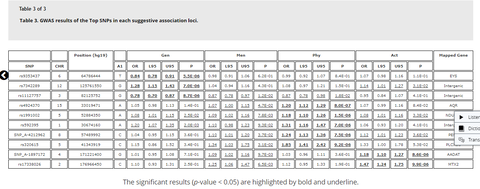
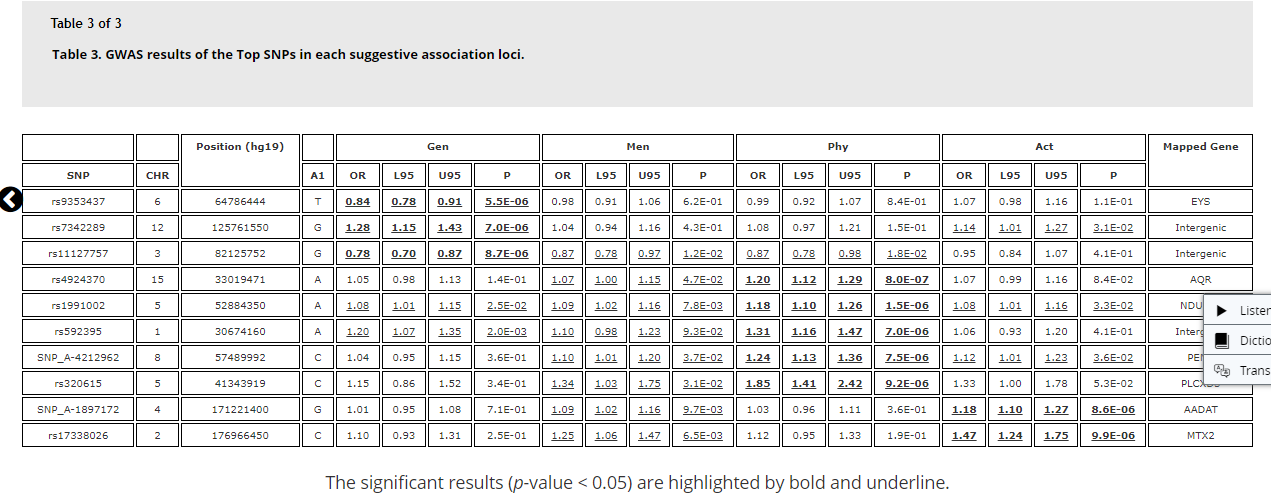
As a result, three loci were identified for GenST, no significant loci were observed for MenST, four loci were identified for PhyST, and two loci were identified for ActST.
The most significant SNP of GenST (rs9353437) was located in an epidermal growth factor gene (eyes shut homolog, EYS) and expressed in the photoreceptor layer of the retina.
The genome-wide association studies’ (GWAS) results of PhyST showed a significant SNP (rs4924370) in a spliceosomal factor (Aquarius intron-binding spliceosomal factor, AQR). Notably, the second most significant SNP (rs1991002) was located in an oxidoreductase gene (NADH:Ubiquinone Oxidoreductase Subunit S4, NDUFS4) and was also marginally associated with GenST, MenST, and ActST (p-value < 0.05).
A recent survey conducted on Korean’s stress levels showed that about 40% of the participants replied that they experience a high degree of stress (So, 2018).
Further, a T1521C polymorphism in the GABRA6 gene, which belongs to the g-aminobutyric acid (GABA) system responsible for inhibiting the hypothalamic-pituitary-adrenal (HPA) axis and the locus coeruleus-norepinephrine (LC/NE) system, is related to specific personality traits, ANS function (blood pressure), and endocrine effects related to stress (Uhart et al., 2004).
Jiwon Yang
Accepted 07 Oct 2021
So, W. (2018). Stress self-assessment in South Korea 2018. Statista.
http://www.statista.com
②理由は知らんが、1人で書いた異例の論文で2020/9/21提出してからAccepted07 Oct 2021と1年以上かかっている
③T1521C polymorphism in the GABRA6 gene
transporter gene (SLC6A4) (Karg et al., 2011)
the glucocorticoid receptor gene (NR3C1) (Lian et al., 2014).
NR3C1についてSNV-1は、 58 であり、SNV/ns-1は、1。
GABRA6 ....is related to specific personality traits
GABRA6は62で非同義バリアンツはゼロ
serotonin transporter gene (SLC6A4)
SLC6A4は18で非同義バリアンツはゼロ
Thus, this study aims to identify genes that may affect the risk of stress in a large-scale Korean cohort.
Genome-wide association studies of approximately 320,000 SNPs acquired from the Korea Centers for Disease Control and Prevention (KCDC) were conducted to explore the risk of stress in the four categories.
The stress survey used in this study consisted of 40 questions, organized into the following four categories: 10 questions on General Stress (GenST); 10 questions on Mental Stress (MenST); 10 questions on Physical Stress (PhyST); and 10 questions on Activity Stress (ActST).
As a result, three loci were identified for GenST, no significant loci were observed for MenST, four loci were identified for PhyST, and two loci were identified for ActST.
The most significant SNP of GenST (rs9353437) was located in an epidermal growth factor gene (eyes shut homolog, EYS) and expressed in the photoreceptor layer of the retina.
The genome-wide association studies’ (GWAS) results of PhyST showed a significant SNP (rs4924370) in a spliceosomal factor (Aquarius intron-binding spliceosomal factor, AQR). Notably, the second most significant SNP (rs1991002) was located in an oxidoreductase gene (NADH:Ubiquinone Oxidoreductase Subunit S4, NDUFS4) and was also marginally associated with GenST, MenST, and ActST (p-value < 0.05).
A recent survey conducted on Korean’s stress levels showed that about 40% of the participants replied that they experience a high degree of stress (So, 2018).
Further, a T1521C polymorphism in the GABRA6 gene, which belongs to the g-aminobutyric acid (GABA) system responsible for inhibiting the hypothalamic-pituitary-adrenal (HPA) axis and the locus coeruleus-norepinephrine (LC/NE) system, is related to specific personality traits, ANS function (blood pressure), and endocrine effects related to stress (Uhart et al., 2004).

コメント